

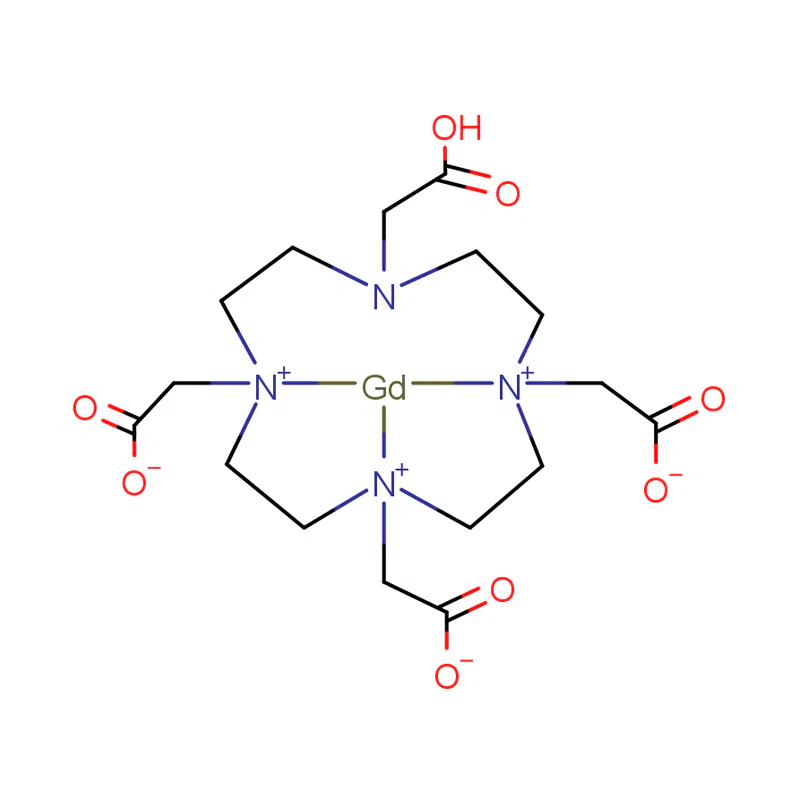
Product Description of Gadolinic Acid CAS#72573-82-1
Gadoteric Acid (CAS#72573-82-1), also known as DOTA-Gd, is a macrocyclic paramagnetic gadolinium complex. It appears as white to off-white solid powder, with molecular formula C₁₆H₂₅GdN₄O₈ and molecular weight 558.65.
This pharmaceutical raw material serves as the key active ingredient for MRI contrast media. It shortens T1 relaxation time to enhance imaging contrast for brain and spinal examinations. The material needs dry and sealed storage to prevent structural degradation and retain its imaging-related chemical performance.

Gadoteric Acid Chemical Properties
| English Name | Gadoteric acid |
| English Synonyms | Gadoteric acid;Gadoteric;Gadolinate(1-),[1,4,7,10-tetraazacyclododecane-1,4,7,10-tetraacetato(4-)-kN1,kN 4,kN7,kN10,kO1,kO4,kO7,kO10]-, hydrogen (1:1);Gadolinium 2-[4,7,10-tris(carboxymethyl)-1,4,7,10-tetraaz acyclododec-1-yllacetic acid;Gd-DOTA;2-[4,7-bis(carboxylatomethyl)-10-(carboxymethyl)-1,4,7,10-tetrazacy clododec-1-yl]acetate;Gadotericaci;2,2",2"-(10-(carboxymethyl)-1,4,7,10-tetraazacyclododecane-1,4,7-triyl) triacetate Gd3+ |
| CAS Number | 72573-82-1 |
| Molecular Formula | C16H25GdN408 |
| Molecular Weight | 558.65 |
| EINECS Number | 1533716-785-6 |
| Melting point | >300°C(decomposition) |
| Boiling Point | 701.6 ℃ at 760 mmHg (estimated) |
| Flash Point | 378.1 ℃ |
| Solubility | Slightly soluble in water; poorly soluble in common organic solvents |
| Form | Solid |
| Color | White to off-white |
| Storage conditions | Refrigerated storage, keep sealed and dry |

Product Application of Gadolinic Acid CAS#72573-82-1
Gadolinic acid functions as an MRI contrast agent without direct therapeutic activity. Given by intravenous injection, it alters local magnetic field conditions, making abnormal tissues such as tumors and inflammatory lesions display higher contrast on scans and raising overall diagnostic precision. It is widely adopted for lesion inspection of brain and spine, as well as magnetic resonance angiography for other anatomical regions.
Relevant studies show favorable safety profiles for pediatric subjects including newborns in central nervous system and whole-body imaging, delivering reliable image enhancement to assist clinical diagnosis.