
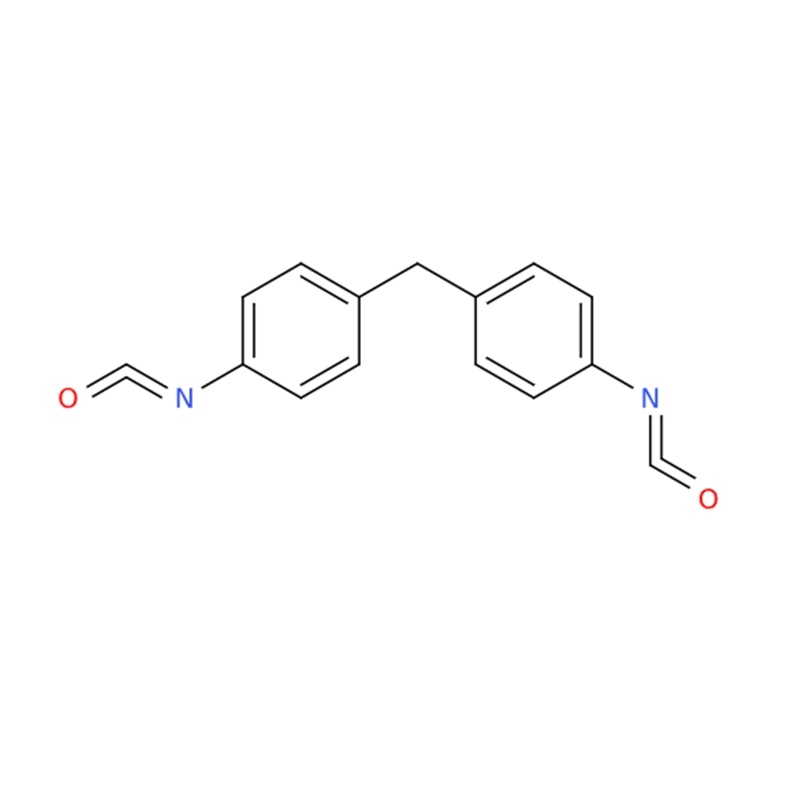
4,4'-Diphenylmethane Diisocyanate CAS#101-68-8
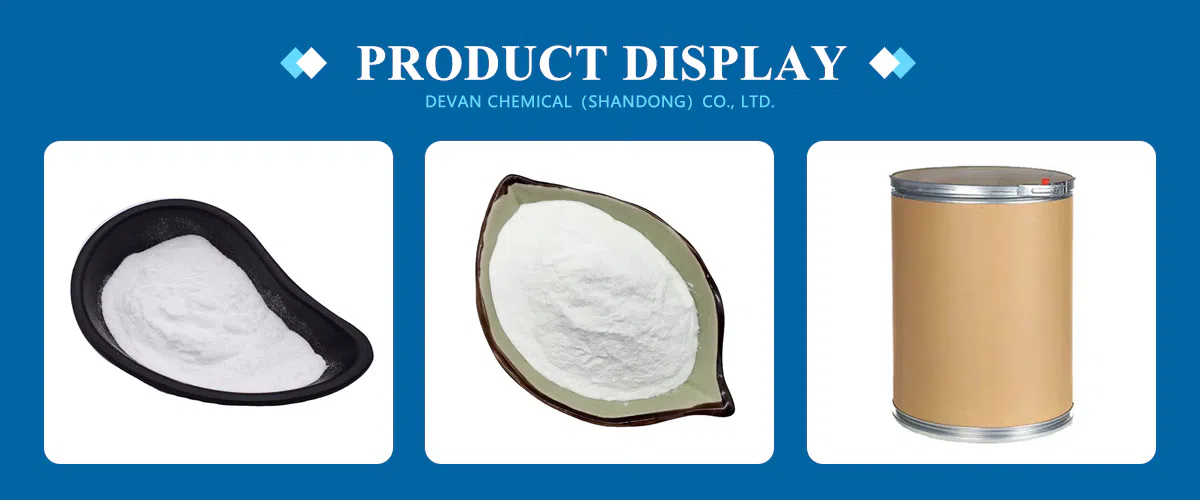
4,4'-Diphenylmethane diisocyanate, abbreviated as MDI, is an aromatic diisocyanate. Its molecular formula is C₁₅H₁₀N₂O₂ with molecular weight of 250.25 g/mol. Pure MDI is a white or pale yellow crystalline solid at room temperature. It gradually turns yellow upon exposure to air and light due to oxidation.
The compound reacts readily with water, alcohols and amines. It must be kept tightly sealed under dry and inert atmosphere. Avoid contact with moisture, as it will form insoluble urea precipitates and cause quality deterioration.
4,4'-Diphenylmethane diisocyanate Chemical Properties
| Melting point | 38-44 °C |
| Boiling point | 392 °C |
| density | 1.19 |
| vapor pressure | 0.066 hPa (20 °C) |
| refractive index | 1.5906 (estimate) |
| Fp | 196 °C |
| storage temp. | -20°C |
| solubility | 2g/l (decomposition) |
| form | solid |
| color | White to Almost white |
| Specific Gravity | 1.18 |
| explosive limit | 0.4%(V) |
| Water Solubility | decomposes |
| FreezingPoint | 37℃ |
| Sensitive | Moisture Sensitive/Lachrymatory |
| BRN | 797662 |
| Dielectric constant | 10.0(Ambient) |
| Exposure limits | TLV-TWA 0.051 mg/m3 (0.005 ppm) (ACGIH and NIOSH); ceiling (air) 0.204 mg/m3 (0.02 ppm)/10 min (NIOSH and OSHA); IDLH 102 mg/m3 (10 ppm). |
| Stability: | Stable. Combustible. Incompatible with strong oxidizing agents. Reacts violently with alcohols. |
| InChI | 1S/C15H10N2O2/c18-10-16-14-5-1-12(2-6-14)9-13-3-7-15(8-4-13)17-11-19/h1-8H,9H2 |
| InChIKey | UPMLOUAZCHDJJD-UHFFFAOYSA-N |
| SMILES | O=C=Nc1ccc(Cc2ccc(cc2)N=C=O)cc1 |
| CAS DataBase Reference | 101-68-8(CAS DataBase Reference) |
| NIST Chemistry Reference | Benzene, 1,1'-methylenebis[4-isocyanato-(101-68-8) |
| IARC | 3 (Vol. 19, Sup 7, 71) 1999 |
| EPA Substance Registry System | 4,4'-Methylenedi(phenyl isocyanate) (101-68-8) |
Safety Information
| Hazard Codes | Xn,T,C |
| Risk Statements | 42/43-36/37/38-20-48/20-40 |
| Safety Statements | 45-36/37-23 |
| RIDADR | 2206 |
| OEB | D |
| OEL | TWA: 0.05 mg/m3 (0.005 ppm), Ceiling: 0.2 mg/m3 (0.020 ppm) [10-minute] |
| WGK Germany | 1 |
| RTECS | NQ9350000 |
| Autoignition Temperature | >600 °C |
| Hazard Note | Toxic/Corrosive/Lachrymatory/Moisture Sensitive |
| TSCA | TSCA listed |
| HazardClass | 6.1 |
| PackingGroup | II |
| HS Code | 29291090 |
| Storage Class | 11 - Combustible Solids |
| Hazard Classifications | Acute Tox. 4 Inhalation |
| Carc. 2 | |
| Eye Irrit. 2 | |
| Resp. Sens. 1 | |
| Skin Irrit. 2 | |
| Skin Sens. 1 | |
| STOT RE 2 Inhalation | |
| STOT SE 3 | |
| Hazardous Substances Data | 101-68-8(Hazardous Substances Data) |
| Toxicity | LD50 orally in Rabbit: > 5000 mg/kg LD50 dermal Rabbit > 9000 mg/kg |
| IDLA | 75 mg/m3 |
Product Application of 4,4'-Diphenylmethane Diisocyanate CAS#101-68-8
4,4'-Diphenylmethane diisocyanate (MDI) finds extensive utilization in the manufacturing of polyurethane coatings and foams. Polyurethane foams synthesized from MDI are regularly adopted for thermal and cryogenic insulation systems, construction materials, automotive components and marine fittings.
Additionally, it is employed to produce automotive interior parts, cushion materials, synthetic leather, solid polyurethane products, polyurethane elastomers, films and adhesives, demonstrating vast application prospects throughout industrial and consumer markets.