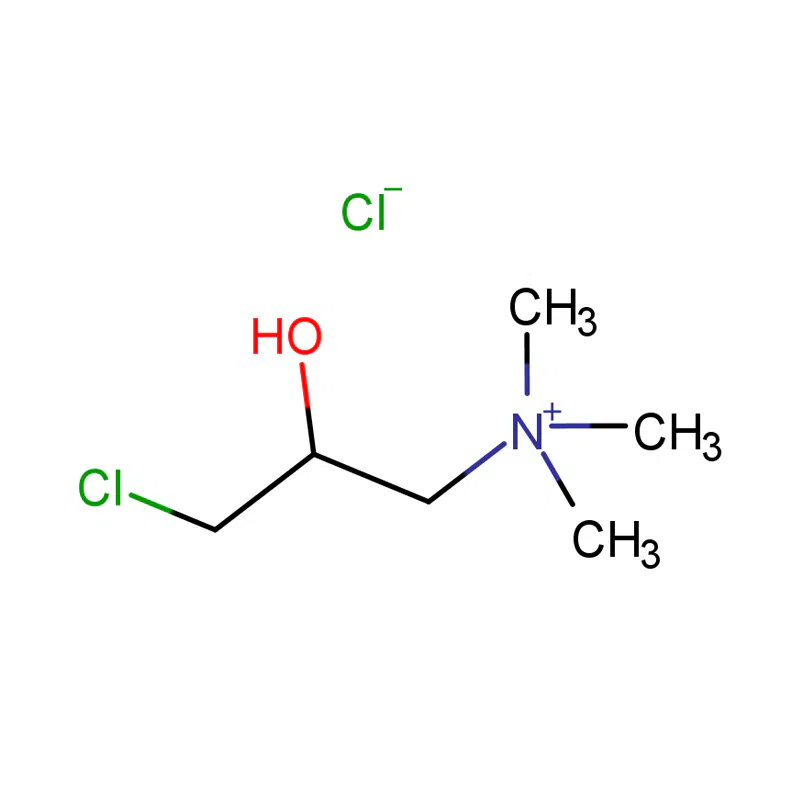
Products Description of 3-Chloro-2-hydroxypropyltrimethyl ammonium chloride CAS#3327-22-8
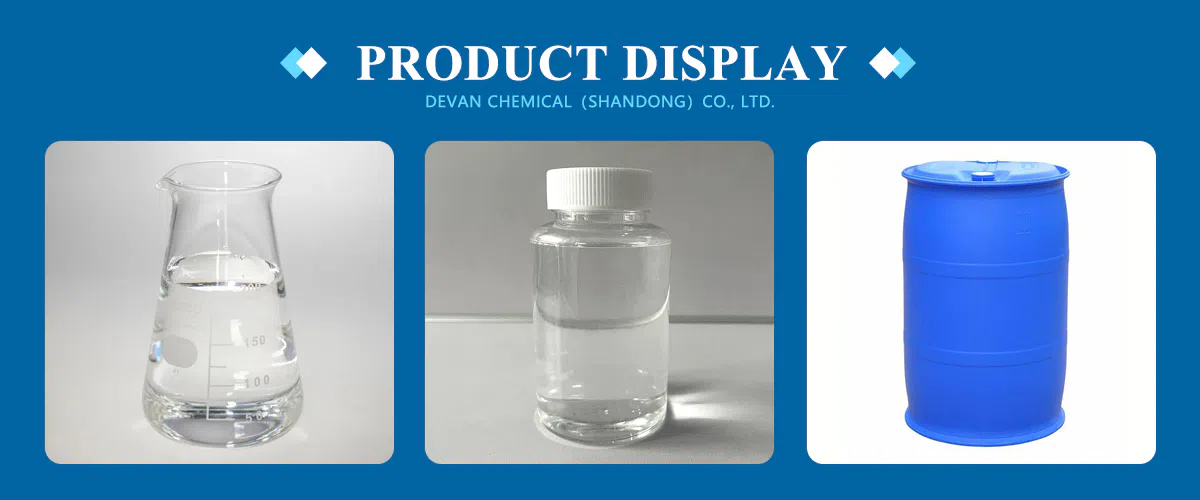
3-Chloro-2-hydroxypropyltrimethyl ammonium chloride, commonly abbreviated as CHPTAC, is a cationic quaternary ammonium reagent with a molecular formula of C6H15Cl2NO and a molecular weight of 188.10. It is commercially supplied as a colorless to light yellow clear aqueous solution, typically with an active content of about 65%. The product has a density of approximately 1.154 g/mL and is fully miscible with water.
As a highly reactive cationic etherifying agent, CHPTAC is widely used to introduce quaternary ammonium groups onto starch, cellulose and guar gum, thereby producing cationic derivatives applied in papermaking, textile finishing, personal care and water treatment.
3-Chloro-2-hydroxypropyltrimethyl ammonium chloride Chemical Properties
| Melting point | 191-193°C |
| density | 1.154 g/mL at 25 °C |
| vapor pressure | 0.001Pa at 20℃ |
| refractive index | n20/D 1.4541 |
| Fp | >230 °F |
| storage temp. | Sealed in dry,Room Temperature |
| solubility | Methanol (Slightly), Water (Sparingly) |
| form | clear liquid |
| color | Colorless to Light yellow |
| PH | 4.8 to 6.4(50g/L, 25℃) |
| Water Solubility | 835.2g/L at 20℃ |
| BRN | 6576172 |
| InChI | InChI=1S/C6H15ClNO.ClH/c1-8(2,3)5-6(9)4-7;/h6,9H,4-5H2,1-3H3;1H/q+1;/p-1 |
| InChIKey | CSPHGSFZFWKVDL-UHFFFAOYSA-M |
| SMILES | [N+](C)(CC(O)CCl)(C)C.[Cl-] |
| LogP | -1.5 at 25℃ |
| CAS DataBase Reference | 3327-22-8(CAS DataBase Reference) |
| EPA Substance Registry System | 3-Chloro-2-hydroxypropyltrimethyl ammonium chloride (3327-22-8) |
| Hazard Codes | Xn |
| Risk Statements | 36/37/38-52/53-40 |
| Safety Statements | 26-36-61-36/37 |
| RIDADR | 2811 |
| WGK Germany | 2 |
| RTECS | BP5275400 |
| HS Code | 2923.90.0100 |
| HazardClass | 6.1(b) |
| PackingGroup | III |
| Toxicity | LDLo subcutaneous in mouse: 500mg/kg |
Product Application of 3-Chloro-2-hydroxypropyltrimethyl ammonium chloride CAS#3327-22-8
CHPTAC acts as a versatile cation-active auxiliary across multiple manufacturing sectors.
Paper-making sector. It modifies starch, cellulose and its derived substances via etherification. The yielded cation-modified starch can work as paper-strengthening additive, internal sizing binder, filler and retention agent for tiny fibre fragments.
Textile processing field. After reacting with cotton fibre, it improves the adhesive capacity of dyestuffs. Its modified cationic starch also serves as the sizing substance for warp threads.
Water-purification industry. Suspended particulate contaminants in water carry negative surface charges. Cation-rich polymers prepared with this raw-material function as flocculants for water treatment.
Personal-care chemical sector. It helps synthesize cationic guar gum and other ether-modified derivatives, which constitute essential raw-materials for everyday-use chemical commodities.